Development and Heritage Preservation
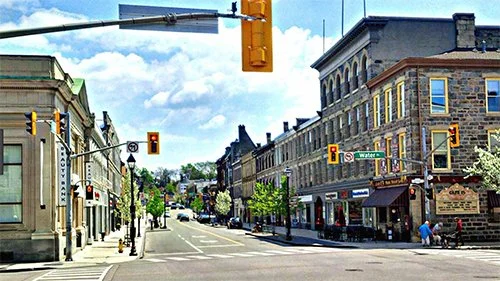
At the time of the 2022 municipal election, nobody could have predicted the legislation that would issue from Queen's Park during the four year term.
The focus of the Ford government on building more homes faster led to several initiatives, one of which was to impose on municipalities a deadline of December 31, 2026, to designate listed properties under the Heritage Act or have them lose protection from demolition and development.
Cambridge reacted by enhancing its heritage planning capacity and addressing as many as possible of the 650 properties it had listed, sometimes a dozen or more at a single council meeting. Many affected by this effort were upset that heritage regulations would increase costs of renovations and repairs.
I introduced a motion that, as a temporary measure, raised the available grant money for 2026 from $30K to $100K, and the individual grant amount from $5K to $7.5K, while directing staff to develop a more permanent means of offsetting the costs being imposed on homeowners for 2027 and beyond.
You can see the original motion here
The original motion was modified during the meeting to increase the fund from the $60K that I had proposed to $100K and to insert the increased individual grant amount from $5K to $7.5K.
Frank Miseferi Story
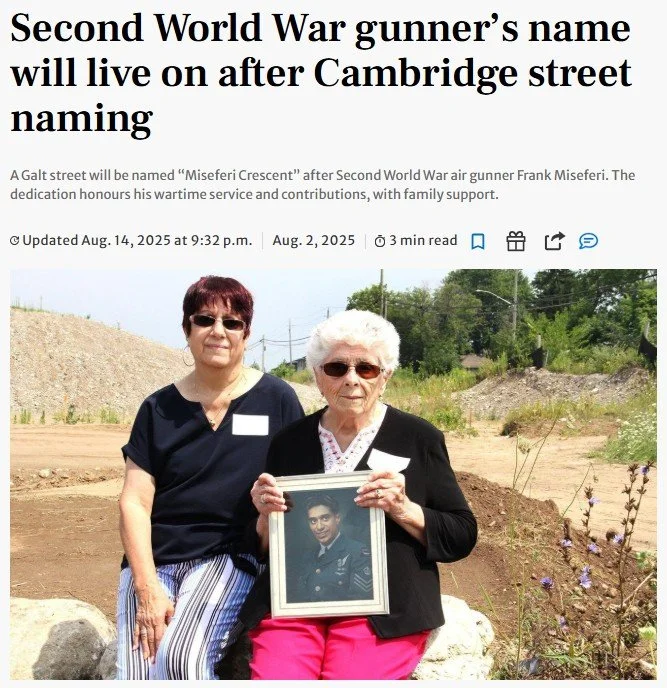
Ross Earnshaw helped ensure that Frank Miseferi’s name and wartime service will be remembered for generations in Cambridge.
Frank Miseferi, a Second World War air gunner from Galt, will be honoured through the naming of Miseferi Crescent, a new street that will permanently recognize his contribution. The dedication reflects Frank’s service, his connection to the community, and the determination of his family to see his story preserved.
Ross supported the effort by helping move the street-naming request through the municipal process and working with the family to help turn a meaningful idea into a lasting public tribute. His involvement helped ensure that the recognition was not simply symbolic, but part of the city’s living history - a name residents will see, use, and remember.
The story is also a reminder that local history is built through individual lives and family memories. By helping secure this street naming, Ross played a role in honouring a Cambridge veteran and strengthening the connection between today’s community and those who served before us.
Miseferi Crescent will stand as a lasting tribute to Frank Miseferi, his wartime service, and the family and community who worked to keep his legacy alive.
Asset Management and Fiscal Responsibility

Over the past several years, the City has developed an asset management plan - essentially a scorecard listing the city's assets, assessing their state of repair, and establishing a maintenance plan.
This exercise has revealed an "infrastructure gap"; that is, the monetary difference between the expenditure recommended for proper maintenance of city assets and the amount provided in the operating budget. Infrastructure is not just about concrete and steel; it is about the essential systems that enable societies and economies to function effectively and equitably.
Not only is the Cambridge "gap" a staggering figure of $169 million (2026 budget document) but it had been growing annually while city assets like buildings, bridges, streets, water mains and sewers had been deteriorating slowly. Anyone who owns a home or a car will recognize that prudent, consistent maintenance is more fiscally responsible than allowing an asset to fail prematurely, then having to replace it.
To address this growing problem, I introduced a 2024 budget motion that resulted in adoption of a 1% "infrastructure levy" in the 2024 city budget. This measure is designed to slowly reduce and eventually eliminate the "gap". It has been carried forward into the 2025 and 2026 budgets and, if re-elected, I will continue to advocate for it to appear in future city budgets.
Light Rail Transit and the Future of Downtown Galt
In this short video, Ross Earnshaw discusses what the arrival of light rail transit could mean for Cambridge, with a particular focus on downtown Galt. Standing near an existing ION station, Ross frames LRT as more than a transportation project. He presents it as a city-building opportunity: a way to connect Cambridge more effectively with Kitchener and Waterloo, bring more people into the downtown, support local businesses, and encourage new investment along the transit corridor.
The message is practical and forward-looking. Ross recognizes that major infrastructure projects raise questions about cost, disruption, timelines, design, and impacts on existing streets and neighbourhoods. At the same time, he argues that Cambridge needs to look carefully at the long-term benefits of stronger regional transit. The Region’s Stage 2 ION plan would extend LRT from Fairway Station to downtown Cambridge, creating a more seamless rapid-transit link across the region. Better connections can help residents reach work, school, services, shops and community destinations without depending entirely on cars, while also supporting a more active and economically vibrant downtown.
The video also connects LRT to the broader future of Galt. Ross suggests that the project should be planned in a way that respects the character of the downtown while helping it grow. Done well, light rail can help bring foot traffic, confidence, and renewed attention to the core. It can also strengthen Cambridge’s place within Waterloo Region by making the city feel more connected to the larger regional economy.
Overall, Ross’s message is that LRT should be seen not only through the lens of transit, but through the lens of community-building. The opportunity is to ensure Cambridge receives the same level of connection, investment, and planning attention that has already shaped other parts of the Region.
Protecting Unhoused Residents During Extreme Weather
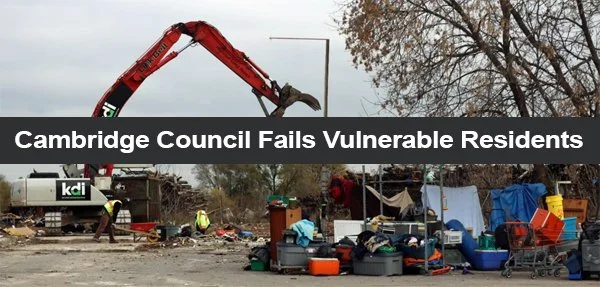
Ross Earnshaw showed leadership on one of Cambridge’s most urgent human issues by seconding Councillor Scott Hamilton’s motion to protect unhoused residents during extreme weather events. The motion asked City staff to report back on how Cambridge could avoid forced removals of encampments during heat waves, cold snaps, storms, floods, and other dangerous conditions.
The issue gained added importance after Canada’s Federal Housing Advocate, Marie-Josée Houle, specifically raised concerns about reports of eviction notices being issued in Cambridge during extreme weather. For Ross, the motion reflected a simple principle: health, safety, and dignity must come first.
This was not an immediate policy or bylaw change. It was a request for information, evidence, options, and better decision-making. By supporting the motion, Ross helped advance a practical and compassionate approach to a complex issue, one that recognizes homelessness as a national crisis while still asking what Cambridge can do locally.
Ross’ support demonstrated a commitment to good governance, human values, and protecting vulnerable residents. It also showed his willingness to ask difficult questions, listen to those affected, and help Cambridge respond with compassion, clarity, and courage.
Protecting Residents from Unsafe Imported Batteries

Ross Earnshaw took action on a growing public safety risk by bringing forward a motion calling for stronger regulation of imported aftermarket lithium-ion batteries that do not meet Canadian safety standards. The motion was inspired by two battery-related fires in his ward, including a serious Avenue Road apartment fire that displaced families and sent five people to hospital for smoke inhalation.
The Cambridge Fire Department determined that the Avenue Road fire was caused by an overheated battery on an e-bike or scooter. While there was no loss of life, the damage and disruption showed how dangerous uncertified lithium-ion batteries can be when they fail.
Working with Cambridge Fire Chief Rob Martin, Ross brought forward a motion urging all levels of government to impose stricter controls on the importation of lithium-ion batteries that are not certified by recognized Canadian safety standards. Fire officials warned that defective batteries can cause intense, long-lasting fires that are difficult to extinguish and may release dangerous toxic gases.
Cambridge Council supported Ross’ motion unanimously. The resolution also backed ongoing public education efforts by Cambridge Fire and the Ontario Fire Marshal. It will be shared with municipalities across Ontario and Canada to build broader support for stronger safety regulations.